Actual texture
This is a combination of how
the painting looks, and how it feels to the touch. It is associated both with
the heavy build up of paint or the addition of materials.

"Taos Mountain, Trail Home" by Cordelia Wilson; ca. 1915-1920s; oil painting. A
landscape entirely executed with a bold impasto technique.
Simulated texture
Creating the visual effect
of texture without actually adding texture.
The artist uses a medium
like a type of paint or pencil to recreate or fool the viewer with a realistic
representation which appears to have actual texture where it does not exist.

“Contract 3”,
painted in 1967 by Bridget Riley, creates the illusion of ripples in the paper
through the repetition of lines.
Invented texture
Some artists who wish to add
a visual texture to an artwork will create a texture to suit their needs rather
than faithfully replicate or abstract an existing texture. Invented textures are not variations of
actual textures. They are not simulations or abstractions, but inventions of
the artist's imagination, used to produce a tactile surface that is not
natural. Invented textures are two-dimensional patterns that
do not represent real surface qualities but evoke memories of unusual
textures.
This texture is created through the use
of a repeated pattern, symbol or mark. Some markings
can also add a sense of activity, movement, motion to that area.
Depending
on the artist's intent, invented textures may not refer to the objective world
and often appear in abstract works.
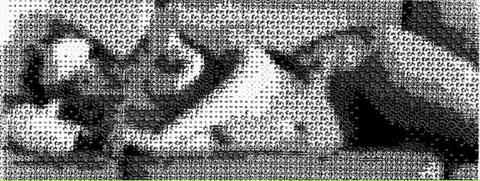
«Nude». Harmon, Leon; Knowlton, Kenneth, 1966
Abstract texture
Artists who want to use a texture in a specific way
may choose to alter or abstract it. Abstract textures usually retain the look
or feeling of the original texture, but it has been modified to meet the needs
of the artist.

"Cubist Still Life With Playing Cards" by Roy
Lichtenstein, 1974.

No comments:
Post a Comment